
Walk into almost any print shop owner’s office, and you’ll find a familiar story. There’s software everywhere—an estimating system, accounting software, maybe a CRM purchased after a compelling sales pitch at the last trade show. The licenses are paid. The logins exist. But is any of it actually working for you?
For small and medium-sized print shops, the pressure to modernize is relentless. You hear it at industry conferences. You see it in trade publications. Competitors seem to be leaping ahead with sophisticated customer management systems. So you invest. And then the reality sets in: the software sits there, partially implemented, while you go back to doing things the way you always have.
Here’s a question worth asking before you add another monthly subscription to the pile: Are you getting 100% out of the software you’re already using?
If the answer is no—and for many print shop owners, it is—then the next question isn’t “What new software should I buy?” It’s “Why am I not getting full value from what I already have?”
The Sobering Reality of CRM Adoption
The CRM industry tells a compelling story. Vendors promise increased sales, better customer retention, and streamlined operations. And the market is booming—CRM software revenue is expected to reach over $260 billion by 2032. But behind the growth numbers lies a troubling pattern that rarely makes it into the sales presentation.
Sources: Gartner, Forrester, C5 Insight research
That’s not a typo. Depending on how you define failure, somewhere between one-third and two-thirds of all CRM projects don’t deliver what they promised. Research from Johnny Grow puts the specific failure rate at 55% when measured against originally planned objectives. And here’s the painful part: many of those failed implementations limp along for months or years before being quietly abandoned.
For a print shop running on 1-3% net margins, that’s not just disappointing—it’s financially devastating.
The Impulse Decision Trap
How do so many businesses end up with CRM software that doesn’t serve them? Often, it starts with an emotional decision disguised as a strategic one.
Picture the scenario: You’re at an industry event. A vendor gives a polished demonstration showing exactly how their CRM will transform your sales process. The dashboard looks beautiful. The automation features seem magical. Other shops are using it. The sales rep mentions a limited-time discount if you sign before the conference ends.
The promise is irresistible: implement this system, and sales will increase. Customer relationships will improve. Your team will be more productive. You’ll finally have visibility into your pipeline.
The reality check: Nearly half of all sales leaders report that their CRM system doesn’t meet their needs. And almost one-third say their customer data is incomplete, outdated, or inaccurate—the very problem the CRM was supposed to solve.
The impulse decision bypasses the critical questions: Does this system integrate with our existing workflow? Do we have the time and expertise to implement it properly? Will our team actually use it? What specific problems are we trying to solve, and is this the right tool for those problems?
Why User Adoption Fails
Here’s an uncomfortable truth that CRM vendors rarely discuss upfront: poor user adoption is the leading cause of CRM failure.
The statistics paint a stark picture:
Think about what these numbers mean for a typical print shop. Your CSRs are already juggling phone calls, proof approvals, job tracking, and production schedules. When you layer a complicated CRM on top of their existing responsibilities, something has to give. Usually, it’s the CRM that gets neglected.
The most sophisticated system in the world won’t help your business if your team sees it as extra work rather than a useful tool. And they will see it that way if the implementation wasn’t planned around their actual workflow.
The Change Management Gap
Here’s where small and mid-sized print shops face a particular disadvantage: most lack experience in change management.
Large enterprises have dedicated teams and substantial budgets for technology transitions. They understand that implementing new software isn’t just about installation—it’s about transforming how people work. They invest in training, communication plans, pilot programs, and ongoing support.
Small businesses typically don’t have those resources. According to research on SMB technology challenges, smaller organizations commonly face:
- Limited time and resources to devote to implementation from planning through execution
- Close-knit workplace dynamics that can contribute to employees being resistant to change
- A general lack of experience in managing major change initiatives
- Difficulty sustaining momentum after the initial rollout
The result? CRM implementations that are technically complete but operationally abandoned. The software exists. The data is supposed to go there. But in the daily chaos of running a print shop, it becomes easier to stick with the familiar spreadsheet or the notes scribbled on a job ticket.
Research shows that training and user adoption are identified as the biggest challenges in CRM implementation by 25% of businesses—and that number is likely higher for organizations that don’t recognize it as a problem until it’s too late.
The Disruption Factor
Every print shop owner knows this truth: you can’t shut down operations to implement new software. Jobs need to ship. Customers need responses. The press needs to run.
Yet CRM implementations often underestimate the disruption they create. Consider what a “simple” CRM rollout actually requires:
- Migrating existing customer data (and cleaning it up in the process)
- Training multiple team members on new workflows
- Integrating with existing systems like your MIS or accounting software
- Changing established habits and processes
- Maintaining data quality going forward
For a print shop processing 30 jobs a day with an average ticket of $88, every hour spent on CRM implementation is an hour not spent serving customers or managing production. The hidden cost isn’t just the software license—it’s the operational drag during the transition period.
And when that transition stretches from weeks into months because adoption is slow and problems keep cropping up, the true cost becomes staggering.
The Abandonment Pattern
Studies suggest that around half of CRM implementations fail within two to three years. But “failure” often doesn’t mean a dramatic shutdown. It’s more insidious than that.
The pattern typically looks like this: Initial enthusiasm gives way to frustration as the system proves harder to use than expected. Key team members quietly stop entering data. Reports become unreliable because the information isn’t current. Management stops checking the dashboards. Eventually, the CRM becomes a zombie system—still running, still costing money, but providing no real value.
By the time anyone admits the implementation failed, the organization has already absorbed the cost—not just in software fees, but in wasted time, disrupted operations, and the opportunity cost of not solving the original problem.
What Print Shops Actually Need
Here’s something that might save you money and frustration: just because your business needs better access to customer data doesn’t mean you need a CRM.
Stop and think about what you’re actually trying to accomplish. Most print shop owners aren’t looking for sophisticated lead scoring algorithms or multi-touch attribution models. They want to know:
- Which customers haven’t ordered recently?
- What’s our average turnaround on reorders?
- Are invoices going out promptly and getting paid on time?
- How can we spot opportunities for additional services?
These questions can often be answered with tools you already have. Your MIS system contains customer history. Your accounting software tracks payment patterns. Your estimating system shows what products customers order most frequently.
Sometimes the solution isn’t new software at all. It’s a better way to organize existing data, a payment system that integrates seamlessly with your invoicing, or simply making better use of what you’ve already purchased.
Before You Buy: Questions to Ask
If you’re considering a CRM—or any significant software investment—take time to honestly assess your situation:
- What specific problem are we trying to solve? Be concrete. “Better customer relationships” isn’t specific enough. “Reducing time to follow up on quotes” is.
- Have we maximized what we already have? Most print shops use less than half the features in their existing MIS. Start there.
- Who will own this implementation? Without a dedicated champion who has time and authority, adoption will fail.
- How will this integrate with our existing workflow? If the answer involves manual data entry or export/import processes, reconsider.
- What does success look like, and how will we measure it? Vague goals lead to abandoned projects.
- Can our team absorb this change right now? Timing matters. A major software transition during your busiest season is a recipe for failure.
The Integration Imperative
If there’s one lesson print shops learn the hard way about business software, it’s this: integration matters more than features.
A payment system that doesn’t talk to your invoicing creates double-entry headaches. An estimating tool that doesn’t sync with accounting means manual reconciliation. A CRM that exists as a standalone database is just another place to enter information nobody will ever look at.
When you evaluate any business tool—CRM or otherwise—the first question should be: how does this work with what I already have? If the answer involves manual data transfer, CSV exports, or “we’re working on that integration,” proceed with caution.
The goal isn’t to have the most sophisticated technology. It’s to have technology that works together to make your operation run smoother, your team more productive, and your cash flow more predictable.
Start Small, Build Momentum
The shops that successfully modernize their operations don’t do it through dramatic overhauls. They do it incrementally. They pick one process that’s causing pain. They improve it. They measure the results. Then they move to the next opportunity.
This approach respects reality. Your team can only absorb so much change at once. Your budget can only stretch so far. Your attention can only focus on so many initiatives simultaneously.
Start with the tools you have. Get full value from those investments before adding more. And when you do add something new, make sure it integrates with your existing workflow rather than creating another information silo.
Ready to Talk About What Your Shop Actually Needs?
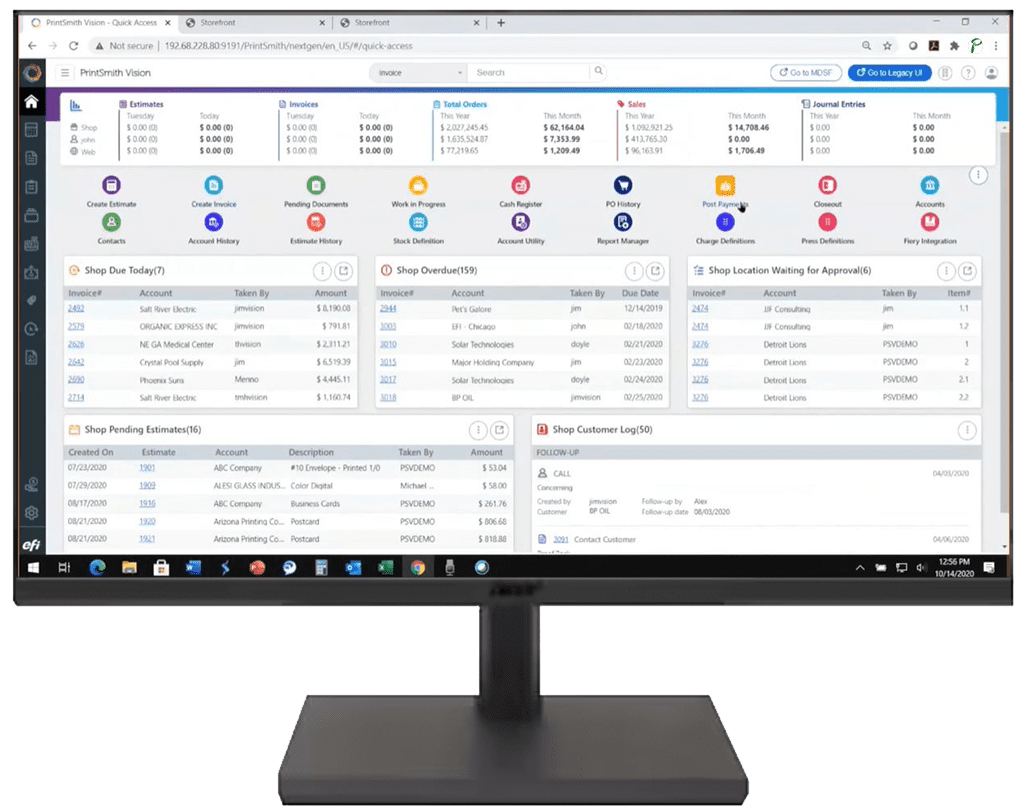
Payably integrates directly with PrintSmith Vision, ensuring every transaction syncs automatically with your existing workflow. No complicated implementation. No change management headaches. No abandoned software. Just faster payments and better cash flow—without disrupting how your team already works.
Contact Us